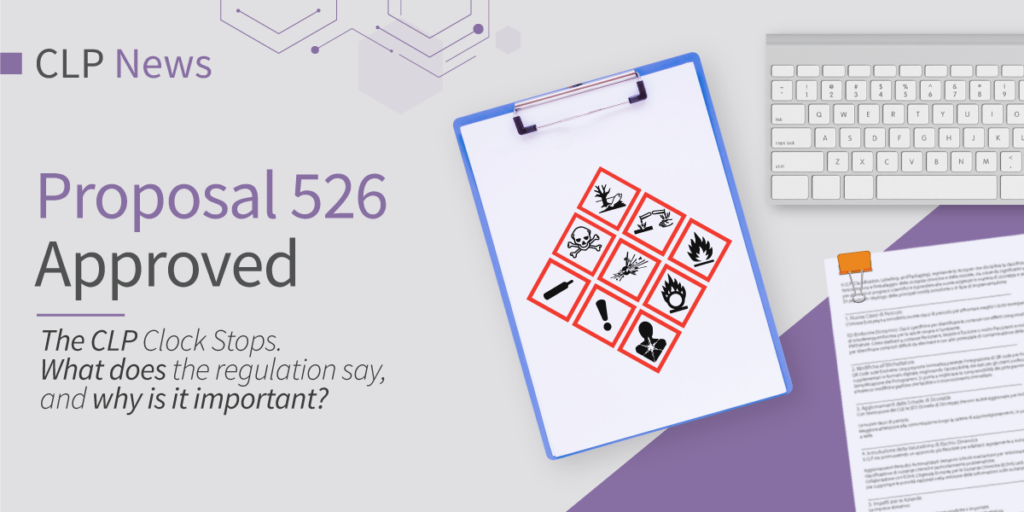


On 17 November, the European Council signed Proposal 2025/0526, also known as the Stop the Clock Regulation, which effectively halts the most recent revision of the CLP.
What does the regulation say, and why is it important?
It is not a true halt, but rather a postponement of the application dates for several rules introduced in the latest CLP revision (Regulation 2024/2865).
With the Stop the Clock Regulation, the application date has been moved to 1 January 2028 for:
- Updating label information (previously 1 July 2026)
- Label updates must be carried out within: (i) 6 months in the case of a more severe classification or new supplemental information, and (ii) 18 months for other changes, such as a less severe classification, updates to P-statements, etc.
- New label format (previously 1 January 2027)
- New minimum font sizes and new packaging rules for containers < 0.5 L;
- Line spacing equal to 120% of the font size and adequate spacing;
- Black text on a white background, same font throughout and sans serif.
- Advertising and distance sales offers (previously 1 July 2026)
- Advertising for hazardous products must display the pictograms, signal word, H-statements and EUH-statements;
- Advertising for products intended for the general public must include the following statement: “Always follow the instructions on the product label.”
- Products placed on the market via distance sales must display all mandatory label elements.
This means that companies now have at least one extra year to comply, considering that these requirements impact labels, and as we know, updating them always demands significant resources.
Application date and future developments
The Stop the Clock Regulation has already been approved and is pending publication.
However, it may soon be followed by another act: the Simplification Regulation (Proposal 2025/0531), which aims to simplify chemical management obligations for European businesses while maintaining health and safety standards.
The content of this new regulation is still under discussion; the main simplifications will likely concern labelling requirements, giving companies greater flexibility in the graphic design of labels.